Mexico’s aerospace industry continues to grow

The Mexican aerospace industry hopes to maintain its growth momentum through long-term investments focused on highly specialized technology. The US$44.8 million investment plan announced by GE Aerospace is an example of this process; this year, the plants in Hermosillo and Saltillo aim to increase production capacity and resolve bottlenecks in the global supply chain.
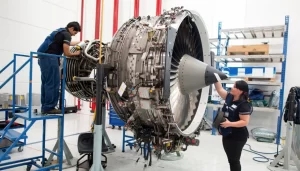
Andrés Soler, CEO of GE Aerospace Querétaro, has stated that 90% of the allocated capital will be concentrated at the Hermosillo plant, which specializes in the manufacture of rotating parts, rotors, and critical, high-precision components for LEAP engines used in aircraft such as the 737 Max and the Airbus A320neo. The remaining percentage will be allocated to the Saltillo, Coahuila, plant, which focuses on the production of wiring harnesses and fluid delivery systems.
“It’s an investment in the country, in the future of the aerospace industry, and in the industrial conditions and talent that Mexico has to offer,” Soler said in an interview with Imagen Radio.
Similarly, the executive noted that the domestic industry has developed significant capacity and highly specialized talent. This center is one of the company’s few facilities—along with its locations in the United States, Poland, India, Turkey, Germany, and Italy—that averages 30 patents granted per year.
The executive explained that despite geopolitical tensions and the review of the USMCA, investment decisions in the sector are based on decades-long maturation cycles. Investments are made with very long cycles in mind that extend beyond political cycles. As a company, we have faced various global situations, but political circumstances will change, and we will have to adapt. “We do take measures based on what’s happening, and fortunately, things have continued to flow smoothly so far,” Soler said.
Similarly, Soler endorsed the Mexico Plan, took the aerospace sector into account, and noted that the industry has followed a trajectory similar to that of the automotive industry in recent decades, following the consolidation of several leading manufacturers; however, the goal now is to develop the domestic supply chain and incorporate Tier 2 and Tier 2 suppliers.