Ford Strengthens Its Position with BYD’s Entry into Mexico in Mind
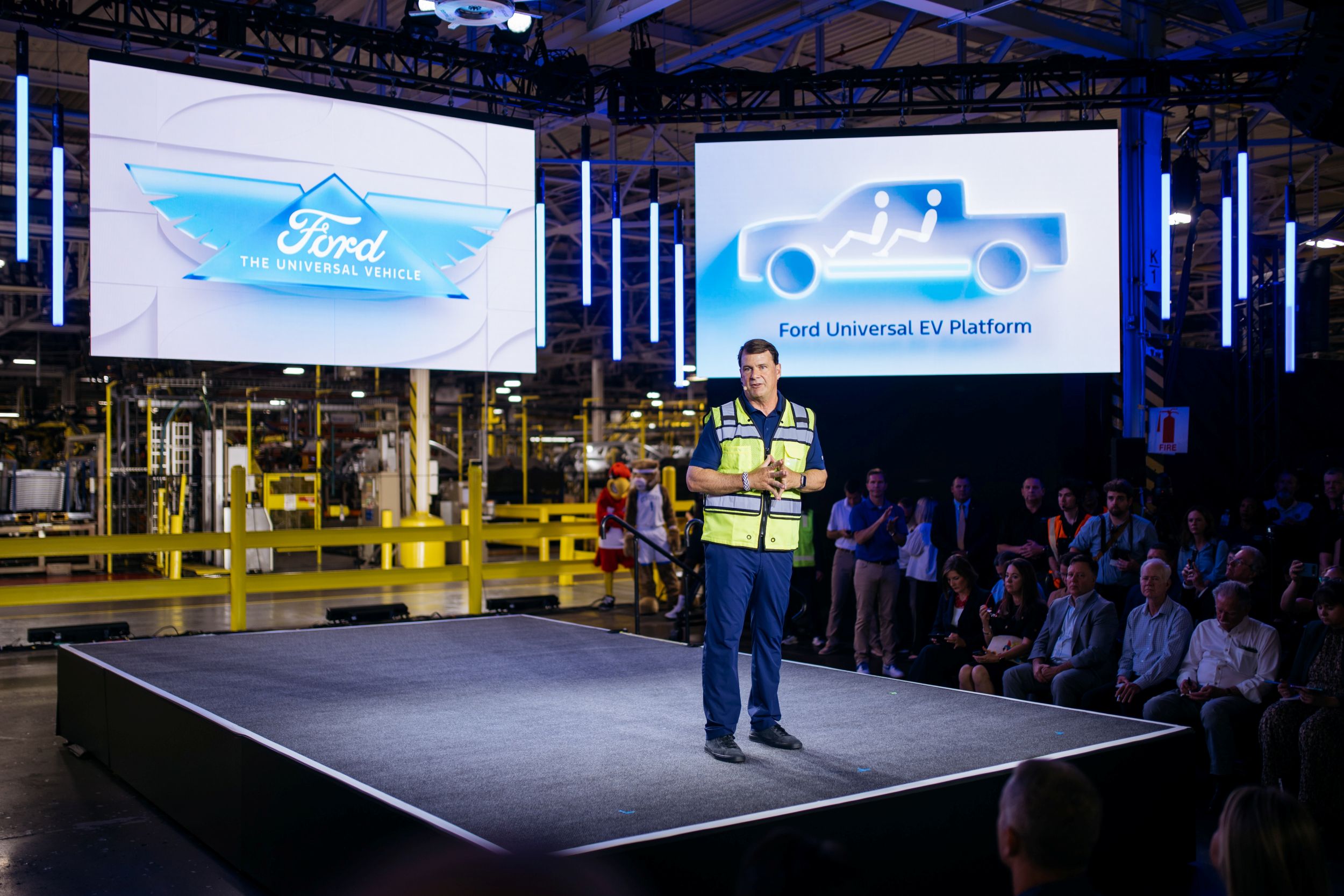
Ford Motor Company is preparing to launch the Ford Fathom with one scenario in mind: that its first affordable electric pickup will be just as competitive as the options BYD would offer if it were to set up an assembly plant in Mexico.
This was revealed by Jim Farley, CEO of the Dearborn, Michigan-based giant, as he explained the motivation behind the company’s new “Model T” moment—a reference to how the debut of its Universal EV Platform (UEV), whose first model will be the Fathom, will change the history of the Blue Oval.
“As for the UEV, we always set the goal—even four years ago—by imagining what a BYD could do in Mexico, not because we expected that to happen, but because we knew that, ultimately, that platform was going to be competitive,” the executive explained during the recent quarterly earnings call.
Farley said the numbers had to be competitive even with the United States as the base of operations, given the cost differences that entails.
“That’s why we’re betting so heavily on innovation—because we had to,” he insisted, before explaining that the major breakthroughs that truly helped reduce the product’s cost boil down to just a couple of things overall.
The first of these, he stated, is the in-house development of components such as the “e-box”—the unit containing the components that regulate the flow of energy between the battery, the powertrain, and the vehicle’s accessories—as well as the rest of the electronics, the electrical architecture, and the advanced driver-assistance systems (ADAS), all of which now cost “much, much less” than sourcing them from a supplier.
“We did it all in-house, and the big benefit would be the cost and the design cost of that,” Farley said, explaining that the second breakthrough was precisely the “radical simplification” of the development and production of the parts.
This approach led them to create the “unicasting” process, in which dozens of structural components are cast into large aluminum parts, with the top of the battery pack also serving as the cabin floor.
The executive and his team revealed that the plant in Louisville, Kentucky, has already produced 5,000 of these parts in series production and that, overall, validation testing of the complex’s processes is 90% complete.
Farley explained that while “unicastings” significantly reduced labor requirements, the focus on simplification led them to another area “where we have a significant advantage over BYD: the efficiency of our motors, gearboxes, and inverters, which are 30% more efficient than theirs,” which in turn allows them to design a much more cost-effective battery.
In this regard, he said that the battery plant located an hour from Louisville has met all operational milestones to date, including comprehensive testing of the electrode mixture—the first step in the production of prismatic LFP (lithium iron phosphate) battery cells—using the same process as the plant in Marshall, Michigan.
The Ford executive emphasized that the production of LFP cells in Marshall is a “major enabler,” as every component of this project was designed with cost efficiency comparable to that in China “to convince us that we would be fully competitive.”
The executive added that this focus on battery development introduced a great deal of new technology and suppliers.
“What we learned from the UEV platform, what we’re learning from Geely, and what we want to strategically retain within the company are all being integrated simultaneously for Kumar and his team,” he said, referring to Kumar Galhotra, global chief operating officer.
Galhotra previously commented at the conference that work is already underway to incorporate advancements in electric motor development into the hybrid models currently in production.
Farley concluded his remarks by referring to the affordable electric platform as a new industrial system that “will be the core of the company” and will be driven by all aspects of “benchmarking,” including suppliers, efficient manufacturing, and even the speed with which a vehicle is created. “This excites us because it represents a major change for Ford,” he concluded.