Hyundai Unveils Plan for 100 Models by 2030
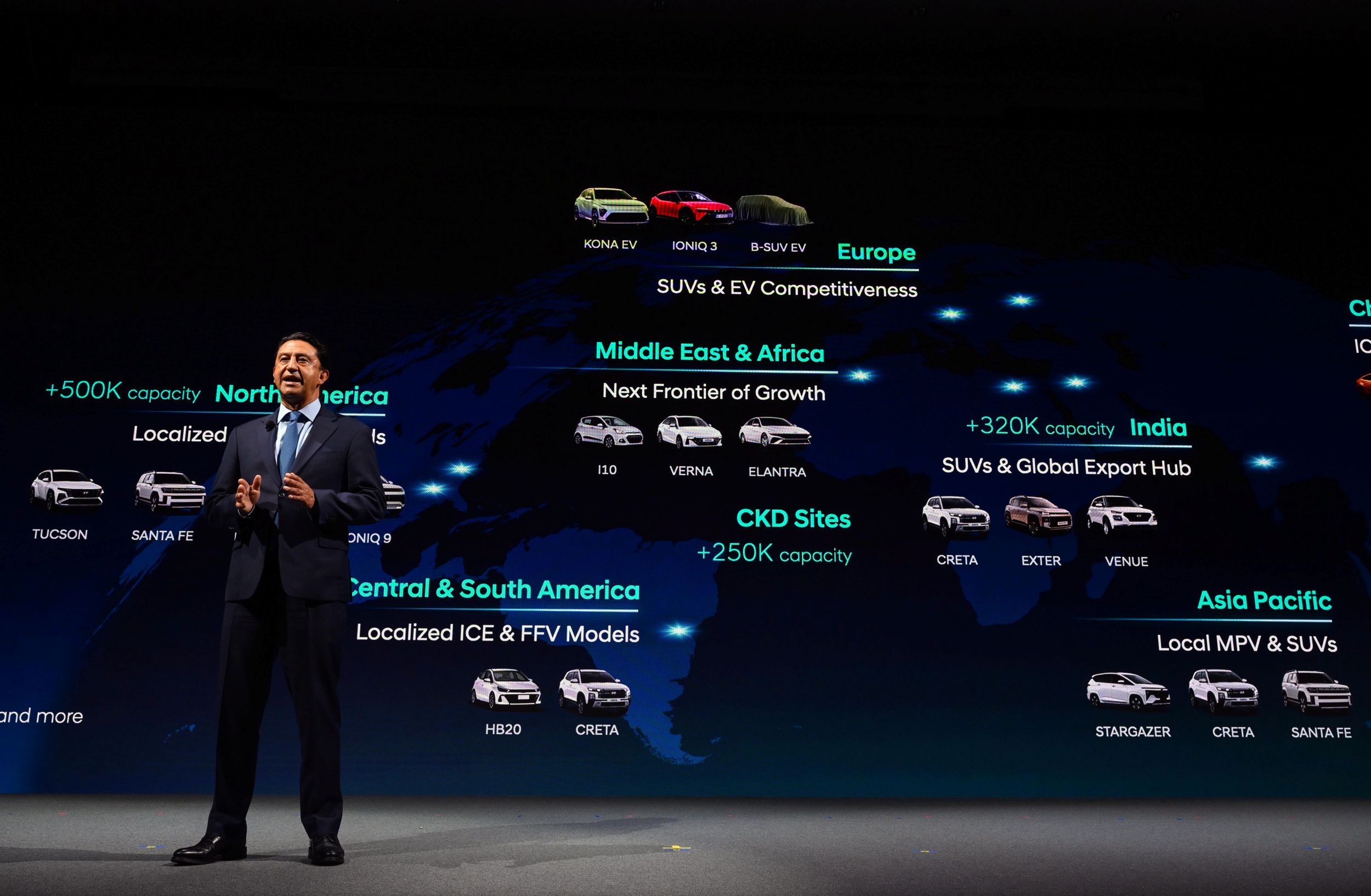
Hyundai Motor Company plans to make North America a production hub for sport utility vehicles (SUVs) and light-duty pickup trucks—both passenger and commercial—as part of a global expansion plan that includes, among other goals, selling 5.55 million units worldwide by 2030.
This was announced by its CEO, Spaniard José Muñoz, during the South Korean automotive giant’s 2026 annual investor conference (Investor Day) held in Seoul.
The strategy calls for the launch of 100 models by 2030, including both new models and redesigned versions, with 58 in North America, 49 in Korea, 41 in Europe, 26 in India, and 22 in China—many of which are intended to enter segments where the company currently has no presence.
Among the confirmed models is the Tucson compact SUV, which the company teased with images just one day earlier, as well as the first version of the Santa Fe with an extended-range electric (EREV) powertrain, which promises a range of more than 966 kilometers (600 miles).
The midsize SUV will be produced at the Alabama plant and will hit the market in the first half of 2027.
The roadmap outlined by Hyundai’s first non-South Korean “CEO” also calls for leveraging partnerships to drive “new technologies and opportunities.”
“We will become a physical AI company that produces and deploys robots and robotaxis,” Muñoz said, adding that this strategy will increase the operating margin from the current 5.6% to a single-digit figure above 9%.
Local Scale for Global Success
Hyundai Motor plans to expand its global production capacity by 1.27 million units by 2030, 500,000 of which will be produced in North America; it also plans to increase the local sourcing of parts from 60% to 80% during the same period.
The increase includes an expansion of 200,000 units at the Meta plant (Hyundai Motor Group Metaplant America, HMGMA), located on the outskirts of Savannah, Georgia, which opened just last year.
By then, Hyundai will offer more than 10 hybrid models in the region, which it estimates will account for 50% of sales.
However, the boldest move is to produce pickup trucks and SUVs in the United States that can compete on a global scale.
To this end, the South Korean automaker plans to develop a range of light-duty trucks beyond the Boulder off-road prototype, and is already preparing a new concept based on the same body-on-frame architecture—tentatively a midsize pickup—which will debut at next year’s New York Auto Show.
According to the executive, the intention is to develop a product family that makes the most of this platform’s capabilities; therefore, the possibility of developing models for the Genesis and Kia brands is also being evaluated, which will require taking their respective supply chains into account.
Hyundai, for its part, plans to debut its first model—a midsize SUV—in 2029.
The company estimates that the “body-on-frame” architecture will allow it to break into new regions and segments dominated by the “Detroit Three,” thereby increasing global sales by 35% to reach 5.55 million units by 2030.
Muñoz explained that the new platform’s expansion is not limited to passenger vehicles but also targets niches such as trucks and commercial vehicles, which account for nearly 30% of the global automotive market and in which Hyundai is not yet present.
According to his projections, entering these segments—along with developing the company’s technology arm through partnerships with companies such as Waymo in the area of robotaxis and Boston Dynamics in the field of humanoid robots—will drive Hyundai’s operating profit margin above 9% by 2030.
“We weren’t competing in nearly 30% of the market, and that market is highly profitable,” the executive said regarding the commercial vehicle segment.