Sheinbaum Unveils Olinia 1 Suburban EV Prototype
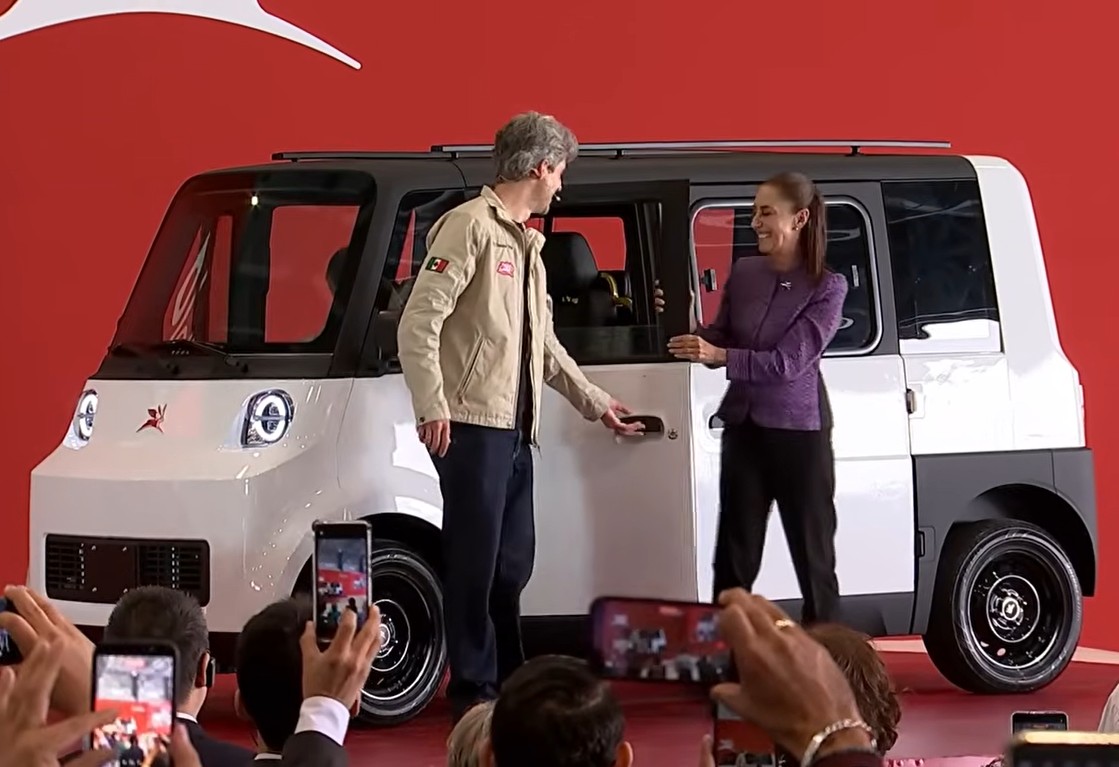
The Mexican government unveiled the Olinia 1 prototype, a suburban electric vehicle with 50% domestic content that will cost US$8,619, with deliveries set to begin next summer.
At the unveiling, the vehicle was driven by Governor Claudia Sheinbaum in Hangar 702 at Military Air Base 1, also known as Santa Lucía, in the State of Mexico.
The vehicle, which seats six passengers, has a range of over 125 kilometers, is powered by a 13.5-kilowatt motor fueled by a 14.7-kilowatt-hour battery, and reaches a top speed of 50 kilometers per hour.
The initiative, “inspired by successful models from countries such as China and India,” was developed through collaboration between research centers and academic institutions under the coordination of the federal government’s Ministry of Science, Humanities, Technology, and Innovation.
According to the development team, the operating cost of this vehicle will be 49 cents per kilometer with an electricity rate of 4 pesos per kilowatt-hour.
Under these criteria, its operating cost will be “five times lower than that of a gasoline-powered vehicle and less than half the cost of operating a motorcycle.”
However, it should be noted that the vehicle does not comply with current safety regulations for light vehicles, particularly NOM-194-SE-2021.
In this regard, the project coordinators indicated that the model was deliberately designed outside the scope of these regulations and that they are already working with the Ministry of Economy to create a regulatory framework tailored to this type of vehicle, as it is a model without precedent in the Mexican market.
This regulation will focus on “low- and medium-speed urban vehicles,” a segment not currently covered by the parameters of the current NOM.
Regarding the development of the supply chain, the federal government has limited itself to stating that the initiative was made possible through a “joint venture” project, involving technology transfer from partners in China, the United States, India, and Germany, with the Innovation Center to be located in the state of Puebla.
However, reports based on the transparency platform indicate that at least two Chinese companies are involved in supplying components: Dayang New Energy Vehicle Co., Ltd. and Henrey Automobile Technology, both of which specialize in ultra-compact electric vehicles.